Tree Trimming & Pruning in DeLand, FL: From Clearance Cuts to Crown Reduction
God's Country Tree Service LLC is a licensed and insured tree service based in DeLand, Florida, serving homeowners and businesses across Volusia County since 2014. One crew handles the whole canopy: clearance and health trimming, structural pruning, crown reduction made with proper reduction cuts (never topping), and recurring maintenance plans for homes and HOAs. Free written estimates within 24 hours, cleanup and hauling included.
A DeLand canopy never stops growing. Oaks put on reach, pines shed deadwood, and every unmanaged season adds weight the next storm gets to play with.
How do you know your DeLand trees are overdue for a trim?
God's Country Tree Service sees the same four signs on overdue DeLand trees: limbs resting on the roof or pool screen, deadwood and Spanish moss thickening inside the canopy, two trunks competing for the lead, and a lawn shaded down to bare sand. One sign means a trim will help; several mean book it before hurricane season.
Limbs on the roof or screen
Branches resting on shingles, gutters, or a pool screen enclosure scrub in every breeze, and hand squirrels a highway onto the house.
Deadwood and heavy moss
Interior dead limbs and thick Spanish moss are the pieces a summer thunderstorm shakes loose first, usually onto whatever is parked below.
Two trunks fighting for the lead
Codominant stems with bark pinched in the union are the classic live oak failure point. Structural pruning picks a winner while the cut is still small.
Bare lawn and blocked views
When a canopy shades the grass down to bare Central Florida sand and swallows the view of the street, it has outgrown its haircut schedule.
What's the difference between tree trimming, pruning and crown reduction?
God's Country Tree Service in DeLand treats them as three jobs. Trimming is scheduled clearance and appearance work. Pruning is corrective work on a tree's structure and health: which limbs stay and where each cut lands. Crown reduction brings an oversized canopy down in size by cutting back to healthy laterals. The estimate visit tells you which one your tree actually needs.
Trimming
Clearance and routine workScheduled cuts that keep limbs off the roof, the pool screen and the driveway, take out deadwood and keep the yard looking kept. The work most DeLand homes book every two to three years.
Pruning
Structure and healthCorrective cuts aimed at the long-term form of the tree: which leader stays, which crossing limb goes, where each cut lands so the wound closes. Young shade trees and codominant oaks need it most.
Crown reduction
Size and storm weightShortening a canopy that has outgrown its spot by cutting each limb back to a healthy lateral, never topping. The storm-season answer for a heavy oak over two rooflines.
What makes professional tree trimming different from DIY cutting?
Topped oaks, lion-tailed limbs, and stub cuts from a ladder all grow back weaker, and cost more to fix than trimming right the first time. The difference is where the cut lands and how the limb comes down.
-
Collar cuts that heal. Every limb comes off at the branch collar: no stubs, no flush cuts, no rot pockets for Florida humidity.
-
Balanced thinning, never stripping. We take the deadwood and problem limbs while keeping the interior growth a canopy needs to stay strong in wind.
-
Rope, saddle, and bucket truck. Proper rigging instead of a leaning ladder keeps the crew safe and your fence in one piece.
-
Honest scope. If your tree needs a light trim instead of corrective pruning, or an arborist's read on whether it can be saved, you'll hear it at the estimate visit.
Which kinds of tree trimming do DeLand yards actually need?
God's Country Tree Service quotes three kinds of tree trimming on DeLand yards: clearance, canopy health and appearance trimming. Clearance lifts limbs off roofs, driveways and pool screen enclosures. Health trimming clears deadwood and thins storm sail in live oaks. Appearance trimming keeps street-facing trees tidy. All three go on one written estimate after walking the yard.
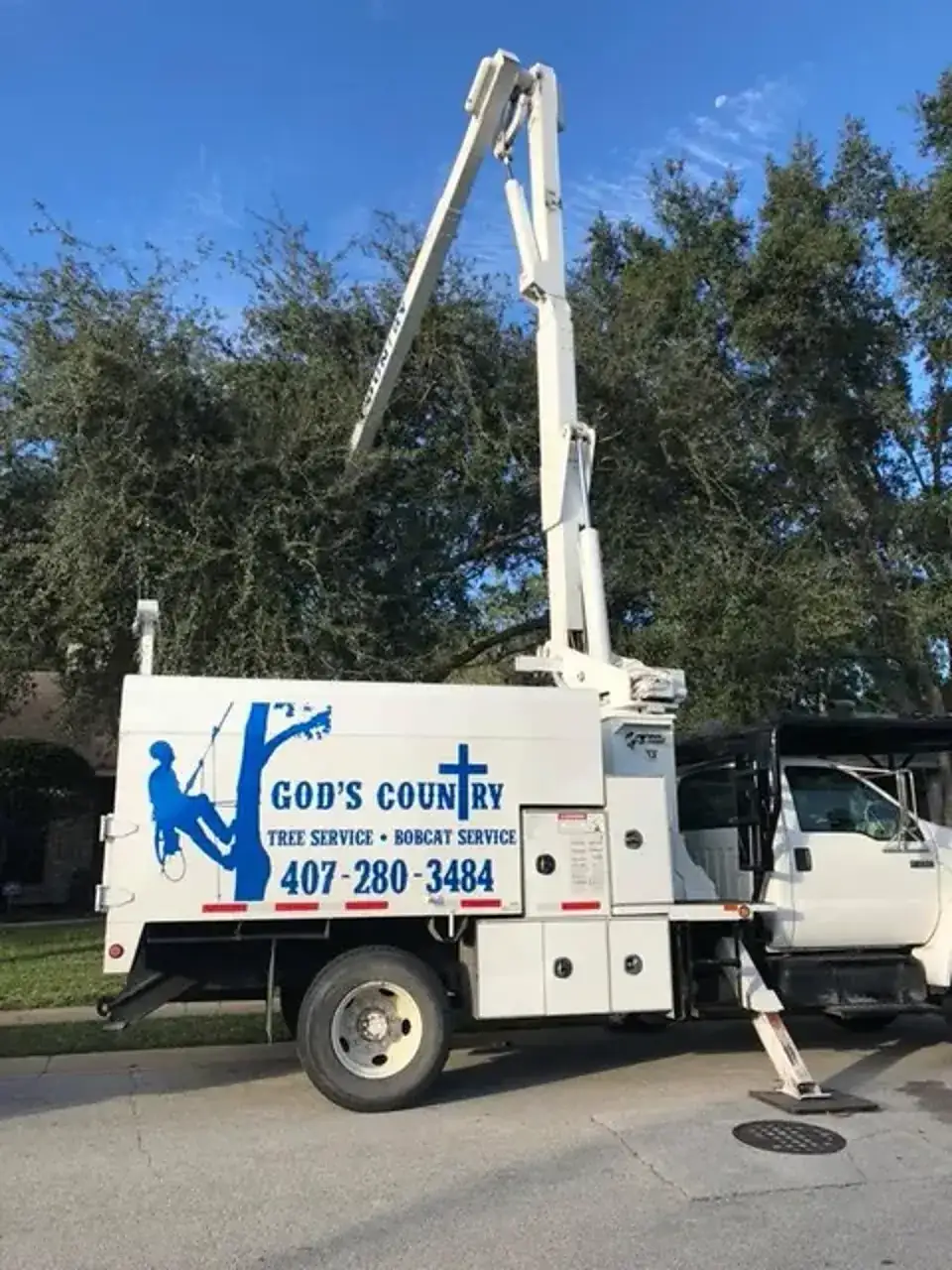
Clearance trimming
Roofs, gutters, driveways, and pool screen enclosures are where an untrimmed oak does its damage first. Clearance trimming lifts and shortens the limbs over your structures, roped, cut in sections, and lowered, never dropped, with enough growth cleared to keep shingles and screens out of reach for years, not one season.
- Roof & gutter clearance
- Pool enclosure protection
- Driveway & walkway lift

Canopy health trimming
Live oaks around DeLand carry heavy interior deadwood, crossing limbs, and enough Spanish moss to hide both. Health trimming opens the canopy so wind moves through it, removes the dead limbs that drop in summer storms, and leaves the strong structure standing.
- Interior deadwood removed
- Less wind sail in storms
- Stronger remaining structure

Appearance and street-facing trimming
Crape myrtles, magnolias, and the street-facing trees carry the curb appeal on DeLand lots, from the historic downtown blocks out to the Stetson University area. Appearance trimming shapes a canopy without butchering it and keeps sightlines open at the end of the drive. Palms are their own job with their own rules, so they have their own page.
- Natural shape preserved
- Clear drive sightlines
- Palms quoted on the same visit
Queen, sabal and fan palms are trimmed by different rules than oaks and pines (no hurricane cuts, only dead fronds and seed pods), so they get their own page: palm tree trimming in DeLand. The same visit can quote both.
Which pruning cuts does God's Country make on DeLand trees?
God's Country Tree Service makes four kinds of pruning cuts on DeLand trees: structural pruning, deadwood removal, crown thinning and clearance pruning. Each cut lands at the branch collar or a healthy lateral so the wound closes, and the written estimate names which cuts each tree gets, so you can phase the work across seasons if you'd rather.
Pruning is where a tree's next twenty years get decided. A live oak that had its codominant leader sorted out as a young tree almost never becomes the midnight emergency over a pool screen. When an HOA or insurer sends a notice about a flagged tree, these are also the cuts that satisfy it; our guide to tree mitigation in DeLand and Volusia County explains what those notices usually ask for, and the prescription pruning guide covers how a written pruning plan works.
-
Cut 01
Structural pruning
On young and maturing trees we select one dominant leader, remove competing stems, and space the scaffold limbs that carry the canopy for decades. A live oak structurally pruned early almost never needs emergency work later.
-
Cut 02
Deadwood removal
Gray, brittle limbs are the first thing hurricane wind takes. We strip deadwood back to live tissue at the branch collar, starting with anything over a roof, driveway, or pool screen enclosure.
-
Cut 03
Crown thinning
Selective interior cuts that let wind pass through the canopy instead of shoving against it: crossing, rubbing, and redundant limbs go, the structure stays. Over-thinned trees sprout back worse, so every cut is deliberate.
-
Cut 04
Clearance pruning
Limbs backed off the roofline, screen enclosure, driveway, and service drops. Made at the right laterals, clearance cuts hold their distance for years instead of months.

What's the difference between crown reduction and topping a tree?
God's Country Tree Service reduces crowns by shortening limbs back to healthy lateral branches that take over the growth, which keeps the tree's structure and shape. Topping slices through the middle of limbs at an arbitrary height, leaving stubs that decay and sprout weak regrowth. One is arboriculture; the other slowly kills DeLand's oaks, which is why we refuse to top.
What the wrong crew does
- Cuts straight through the middle of limbs at whatever height the saw reaches
- Leaves stubs that cannot seal, so decay travels down into the trunk
- Triggers watersprouts: fast, weakly attached regrowth that is more dangerous in wind within a few years
- Strips away the leaves a stressed oak needs to feed itself
- Ruins the natural shape for good; the canopy never recovers its form
How God's Country shapes a crown
- Shortens each limb back to a healthy lateral branch that takes over the growing
- Places every cut where the tree can seal and compartmentalize the wound
- Keeps the natural silhouette: smaller and balanced, still recognizably your oak
- Reduces sail area and limb leverage before hurricane season arrives
- Leaves enough live canopy for the tree to keep feeding itself and stay healthy
We turn down topping jobs, even when a customer asks for one. Topping kills DeLand's live oaks slowly and makes them more dangerous in the meantime. On your walkthrough we'll show you what a proper reduction takes off: the highest leaders back to strong laterals, overextended limbs pulled back from rooflines, select interior branches out so wind passes through, and the lowest limbs lifted for clearance. Our article on tree topping versus crown reduction covers what each does to a Florida oak, and a tree that was topped years ago can often be restored over a couple of seasons by training the strongest sprouts into new leaders.


What does a tree maintenance plan include for DeLand homes and HOAs?
God's Country Tree Service's maintenance plans put a DeLand yard or an HOA's common areas on a calendar: a walk-through inspection of every tree, preventative pruning and deadwood removal while the cuts are still small, clearance held over roofs and screens, and a written watch list before the crew leaves. Each follow-up visit is quoted in writing before it is scheduled.
The maintenance visit
Planned · Predictable · The tree survives- You pick the date: a calm weekday, not the night a storm makes landfall
- Small preventative cuts on a healthy tree, priced in writing up front
- Problems caught at the "watch it" stage, while fixing them is still cheap
- The tree stays, shading the yard instead of leaving a stump in it
The emergency call
Unplanned · Expensive · The tree is gone- The weather sets the schedule, usually at 2 a.m. in the rain
- Emergency work, plus whatever the roof, fence, or pool screen repair costs
- Insurance paperwork instead of a maintenance invoice
- The tree is gone entirely, and decades of shade go with it
Walk-through inspection
Every tree gets looked at from root flare to crown: lean, deadwood, fungus, cavities, weak unions, and limbs creeping toward the roof or pool screen.
Preventative cuts
Dead and structurally weak wood comes out while the cuts are still small and cheap, and clearance is held over roofs, screens and drives.
Watch list & written estimate
Before the crew leaves you hear what was done, what we are watching, and when that tree should be looked at again. Follow-up work goes on a written estimate you approve first.
How often should DeLand trees be trimmed or pruned?
Most mature DeLand oaks should be pruned every three to five years and young shade trees every two to three, with a yearly walk-through ahead of hurricane season. Deadwood over a roof or driveway should not wait for any schedule. Property managers and HOA boards can fold this into a scheduled commercial and HOA tree service contract with documentation for the board.
Young shade trees
Every 2–3 yearsStructural pruning while limbs are still small means small wounds, fast closure, and a tree that never grows its worst habits in the first place.
Mature oaks
Every 3–5 yearsEstablished live oaks and laurel oaks mostly need maintenance: deadwood out, light thinning, clearance held. A steady cycle keeps each visit small.
Ahead of hurricane season
Walk-through yearlyA spring look at what winter left behind. Deadwood over a roof or driveway comes out now, not on the calendar.
When is the best season for tree trimming in Central Florida?
God's Country Tree Service does its heaviest trimming, pruning and crown reduction in the Central Florida dry season, roughly December through February, when oaks are semi-dormant and disease pressure is low. Storm-prep clearance should be finished before hurricane season opens June 1. Light maintenance trimming is safe in DeLand any month of the year.
Prime trimming window
Dry season and semi-dormant oaks make this the best stretch for heavy structural pruning and crown reduction. Wounds close fast, disease pressure is low, and the crew can read the branch structure clearly.
Storm-prep clearance
The countdown to June 1. Clearance trims over roofs and pool enclosures, thinning to cut wind sail, and weight reduction on heavy oaks all belong on the calendar before hurricane season opens.
Hurricane season watch
Lighter maintenance when the weather allows: small deadwood and post-storm damage checks. Heavy canopy work waits for the cool season unless a hazard can't.
Recovery & reset
Storm-season stragglers come off: cracked limbs, hangers, and wind-torn tops. Then the yard gets assessed and booked for the winter pruning window ahead.
How much does tree trimming or pruning cost in DeLand, FL?
God's Country Tree Service prices trimming, pruning and crown reduction in DeLand after an on-site visit, and the cost depends on tree size, how much canopy comes out, and how many trees are on the list. The written estimate names every tree, what comes off it, and the chipping and hauling. The visit and the quote are free.
Size & how many
One crape myrtle is a small job; six mature live oaks worked from the bucket truck are a much bigger one. Height, spread, and the length of the list drive most of the price.
How much comes out
A light clearance lift costs less than a full structural prune or a crown reduction through a moss-loaded canopy. The estimate states exactly what comes off each tree, cut type by cut type, so you can phase the work.
Access & targets
Trimming over a roof, fence, or pool screen means roping and lowering every piece. Open-lawn trees go faster, and the written quote reflects the difference honestly.

Who does tree trimming near me in DeLand, FL?
God's Country Tree Service does tree trimming near you from its base in DeLand, FL. The same crew, bucket truck and chipper cover roughly 50 miles of Volusia County, including DeLeon Springs, Lake Helen, Orange City, Deltona and DeBary. Trimming and pruning are two of the tree services we run from DeLand, so one visit can also quote a removal, a stump or a palm.
What do DeLand homeowners ask before booking tree trimming or pruning?
God's Country Tree Service hears the same questions before a DeLand trimming or pruning job: how often trees need it, whether pruning can save a tree, whether we will top one (no), how much canopy can come off, and what happens to the brush. Each answer below is specific to Volusia County trees.
How often should trees be trimmed in DeLand?
Most DeLand hardwoods do well on a two-to-three-year trimming cycle, while fast growers usually want yearly attention. Anything hanging over a roof, driveway, or pool enclosure deserves an annual look regardless of species. If you're not sure, we'll tell you at the estimate visit. Some trees we look at simply don't need work yet.
Will trimming or pruning hurt my tree?
Not when it's done right. We cut at the branch collar so wounds close naturally, and we avoid stripping interior growth or over-thinning, the mistakes that leave a tree weak and storm-prone. Taking out deadwood and crossing limbs actually reduces stress on the tree, especially heading into a Central Florida summer.
Can pruning save a tree I was told needs to come down?
Pruning can sometimes save a tree that looks like a removal. Storm damage, deadwood, and an overloaded canopy often look worse than they are, and targeted pruning or crown reduction can keep a structurally sound tree standing. Decay at the base or a failing root plate is a different story. We assess the tree at the estimate visit. If pruning will genuinely fix it, pruning is what we quote.
Will you top my tree to make it shorter?
No. Topping is the one cut we won't make. Slicing through the middle of limbs leaves wounds that never close and forces weak, fast regrowth that fails in the next storm. If a tree has outgrown its spot, we quote crown reduction instead: cutting back to healthy lateral limbs so the canopy comes down in size without wrecking the tree.
How much of the canopy can you safely remove?
The working rule for mature trees is no more than about a quarter of the live canopy in one visit, and less for older oaks. Taking more stresses the tree and triggers exactly the weak sprout growth pruning is meant to prevent. When a canopy needs major reshaping, we stage the work across seasons instead of forcing it into one.
Do you haul away all the branches and debris?
Yes. Brush goes through our chipper and leaves on our trucks the same day, and we rake the lawn before we go. Cleanup and hauling are written into the estimate up front, so the price you approve includes the yard being left clean, not a brush pile sitting at the curb.
Can you trim branches near power lines?
We trim around the service drop that runs from the pole to your house, with proper rigging and clearance. Trees in the primary utility lines along the street are the power company's responsibility. If that's your situation, we'll say so at the estimate and handle everything on your side of the pole.
Is it too late to trim once hurricane season starts?
No, a June or July trim still takes weight and wind sail out of a canopy before the busiest storm months of August and September. The ideal time is earlier in the year, but the second-best time is before the next named storm. If the season has already started, ask for clearance over the roof and pool screen first; that is the work that matters most in a storm.
What other tree services do DeLand property owners pair with trimming and pruning?
God's Country Tree Service most often pairs a DeLand trimming visit with three other jobs. Palm tree trimming handles the queen and sabal palms by the drive, an arborist assessment of a declining tree settles the save-or-remove question, and dead and hazardous tree removal takes down the tree that pruning can no longer fix. One crew quotes all of it on one visit.

Palm Tree Trimming
Dead fronds, seed pods and loose boots off queen, sabal and fan palms.
- Fronds & seed pods removed
- No hurricane cuts
- Chipped & hauled same visit
Certified Arborist Services
Expert diagnosis and treatment plans from certified tree professionals.
- Tree health diagnosis
- Honest save-or-remove calls
- Species-specific care plans

Dead & Hazardous Tree Removal
Specialized removal of dead and diseased trees threatening your property.
- Dead & diseased specialists
- Safe extraction & disposal
- Protects roofs & fences
Ready to Get Your Trees Trimmed Before the Next Storm Season Tests Them?
Tell us which trees have gotten ahead of you: the oak over the roof, the two-trunked laurel oak by the fence, the whole shaded-out backyard. God's Country Tree Service LLC will walk the property, recommend only the trimming, pruning or reduction it actually needs, and put the price in writing, tree by tree.
Last Updated: October 2026