Best Trees to Plant in Central Florida Yards (2026)
The best trees to plant in Central Florida yards are live oak for shade, sabal palm for hurricane resistance, bald cypress for wet spots, crape myrtle for color, and Southern magnolia for native wildlife value. All five thrive in zone 9b sand, shrug off storms better than most alternatives, and outlive the fast-growing "bargain" trees that fail in the first big wind.
Quick Answer: What should I plant in a Central Florida yard?
Shade: live oak, bald cypress, winged elm
Small/ornamental: crape myrtle, Eastern redbud, tabebuia
Native/wildlife: Southern magnolia, dahoon holly, sand live oak
Palms: cabbage (sabal) palm — Florida's state tree and a hurricane champion
Avoid: laurel oak near structures, water oak, Bradford pear, camphor, ficus
How Do You Choose a Hurricane-Resistant Tree in Florida?
Choose a hurricane-resistant tree in Florida by picking slow-growing, dense-wooded natives. University of Florida/IFAS post-hurricane studies rank live oak, sabal palm, and bald cypress among the best survivors, while laurel oak, water oak, and queen palm rank among the worst. Fast growth almost always means weak wood.
Wind resistance is the first filter we apply to a planting decision in Volusia County, not an afterthought. The same pattern shows in DeLand yards after a named storm: the dense-wooded natives are usually the ones still standing, and the fast-growing brittle species are the ones that snapped or uprooted. When you plant, you are choosing what will be standing next to your roof in 20 years, so start with species that have already shown they can take a hurricane. For trees already in the ground, check them against these warning signs that a tree is becoming dangerous.
What Are the Best Shade Trees for Central Florida?
The best shade trees for Central Florida are live oak, bald cypress, and winged elm. Live oak gives the widest, longest-lived canopy, bald cypress handles low wet ground where other trees drown, and winged elm is a tough native with a lighter canopy that lets grass survive underneath.
- Live oak is the gold standard for DeLand and Deltona yards: wind-resistant, long-lived, and the classic canopy tree of Central Florida. Its one demand is room. A mature live oak can spread 60 to 80 feet, so it belongs in a large yard, not 10 feet off a foundation.
- Bald cypress tolerates standing water, drops into a handsome winter silhouette, and is surprisingly wind-tough for its size.
- Winged elm is the underused third option: an adaptable native with good storm performance.
Any of the three does best when its branch structure is shaped while the tree is young, which is what a long-term tree maintenance and care plan is for.
What Are the Best Small and Ornamental Trees for DeLand Yards?
The best small and ornamental trees for DeLand yards are crape myrtle, Eastern redbud, and tabebuia. Crape myrtle blooms for months in summer, redbud flowers in early spring on a small native frame, and tabebuia gives the most dramatic display but needs a spot sheltered from cold snaps.
Crape myrtle earns its popularity in smaller Volusia County yards with long summer bloom, handsome bark, and a size for nearly every space. The mistake is "crape murder": topping the tree to stubs every winter, which ruins its form and forces weak, whippy regrowth. Choose a variety that matures at the height you want and it needs almost no pruning. A crape myrtle that has already been topped can often be brought back with selective cuts over a few seasons, the kind of work our tree trimming service in DeLand does.
Eastern redbud gives an early-spring show of purple-pink bloom. Tabebuia has one caveat: it is cold-sensitive, and a hard DeLand cold snap can knock it back, so give it a protected spot.
Which Native Trees Are Best for Wildlife?
The best native trees for wildlife in Central Florida are Southern magnolia, dahoon holly, and sand live oak. Magnolia seed cones feed songbirds, dahoon holly berries draw cedar waxwings and mockingbirds in winter, and sand live oak suits the deep, dry sand around DeLeon Springs and Lake Helen.
Natives are the pick when you want birds, pollinators, and a tree that asks little of you. Southern magnolia is the stately evergreen of the South, with glossy leaves and huge fragrant blooms. Dahoon holly is a small evergreen that also handles wet soil well. Sand live oak is the compact, scrub-adapted cousin of the live oak, with the same excellent wind resistance in a smaller package.
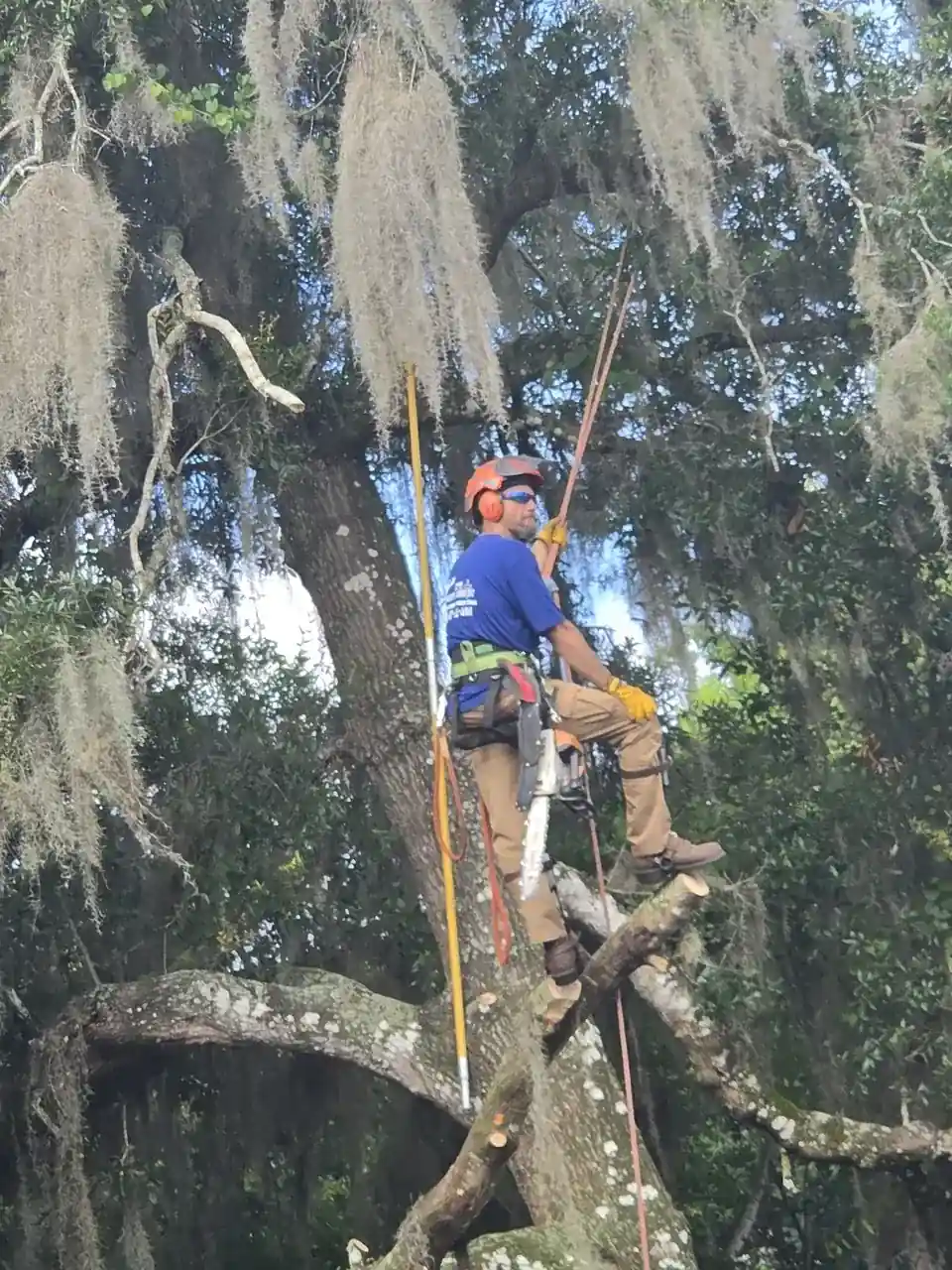
Natives also host the Spanish moss that drapes so many DeLand oaks. If that worries you, read our post on whether Spanish moss is bad for trees. The short answer is no.
Are Palm Trees a Good Choice in Central Florida?
Palm trees are a good choice in Central Florida when you pick the right species. The cabbage palm, also called sabal palm, is Florida's state tree and rides out hurricane winds that snap hardwoods, while the cheap, fast-growing queen palm is among the most storm-weak trees sold here.
Species choice matters more with palms than with almost any other category. The cabbage palm has a flexible trunk and a self-cleaning crown, and it is the default palm we recommend anywhere in Volusia County. Pindo palm and sylvester palm are solid ornamental options where you want a bolder, more sculptural look. The one to skip is the queen palm, which regularly snaps mid-trunk in hurricanes. If a queen palm is what the big-box store has on sale, that is exactly why it is on sale.
Which Trees Should You Avoid Planting in Florida?
Avoid planting laurel oak, water oak, Bradford pear, camphor, and ficus in Florida. These trees grow fast and sell cheap, but they build weak or decay-prone wood, split in storms, spread invasively, or send roots into pipes, and most end up as a removal bill.
- Laurel oak looks like a live oak in the nursery pot but grows fast, builds weak wood, and lives a fraction as long. Never plant one near a structure.
- Water oak is even more decay-prone; mature ones are often hollow.
- Bradford pear has a branch structure prone to splitting, usually in the first serious storm after it matures.
- Camphor is invasive in Florida and seeds itself into fence lines, along with other invasives like chinaberry.
- Ficus combines aggressive, pipe-hunting roots with poor wind resistance.
Planting well the first time is much cheaper than taking one of these down later. If one is already leaning over your roof, see how we remove a tree that stands close to a house and our guide to what drives tree removal cost in DeLand.
What Does "Right Tree, Right Place" Mean?
"Right tree, right place" means sizing the planting spot to the mature tree, not the sapling in the pot. Keep large shade trees at least 20 feet from the house, keep tall species out from under power lines, and keep aggressive rooters away from septic drain fields, pool decks, and driveways.
A live oak planted 8 feet from a foundation is a future roof problem and a likely root conflict. Tall-growing species under power lines get cut back hard by utility crews for as long as they live. Match the species to the spot's sun, drainage, and available crown space, and the tree needs decades of very little from you. Get it wrong and you buy pruning, root damage, or removal instead.
When Is the Best Time to Plant Trees in Central Florida?
The best time to plant trees in Central Florida is late fall through winter. Cooler weather lets roots establish before summer heat arrives, and the June rains then fuel the first strong growth. Planting works year-round here if you commit to deep, regular watering in fast-draining sand.
The bigger factor is our soil. Central Florida sand drains almost instantly and holds few nutrients, so a new tree lives or dies on establishment watering: deep, slow soakings several times a week for the first few months, tapering over the first year or two. Skip that and even the right species in the right spot will struggle. Once established, most of the trees on this list are drought-tolerant in sand.
Is Professional Tree Planting Worth It?
Professional tree planting is worth it when the tree is large, costly, or meant to shade the house for decades. Most planting failures come from the planting itself, not the species: circling roots left uncorrected, a root flare buried too deep, or no watering plan for Florida sand.
Nursery stock quality varies enormously. Circling roots in the pot become girdling roots that slowly strangle the trunk a decade later. Planting depth is the other silent killer: the root flare must sit at or slightly above grade, and trees planted "deep to be safe" suffocate. Done properly, planting means selected stock, corrected root balls, proper depth, staking only when it is needed, and a watering plan matched to Florida sand.
Our tree planting and shrub installation service covers those steps, and an arborist can flag structural issues early. Here is what a certified arborist checks on a young tree. Timing matters for established trees too, so see our month-by-month guide to the best time to trim trees in Florida.
Ready to plant the right tree in DeLand?
God's Country Tree Service has planted and cared for trees across Volusia County since 2014. Ask Caleb and the crew which species fits your yard, your soil, and the next hurricane season.
Get Your Free EstimateCentral Florida Tree Planting FAQs
What is the most hurricane-resistant tree in Florida?
Live oak and sabal (cabbage) palm are the two standouts, with bald cypress close behind. All three rank near the top in University of Florida/IFAS post-hurricane wind studies. Slow-growing, dense-wooded natives survive storms; fast-growing species like laurel oak and queen palm fail most often.
What is the fastest-growing shade tree that is still safe to plant?
Winged elm and bald cypress grow at a respectable pace with good wind resistance. Be wary of anything sold primarily as "fast-growing"; in Florida that usually means weak wood. A live oak grows faster than most people expect with proper establishment watering, and it will outlast every quick alternative.
When should you plant trees in Central Florida?
Late fall through winter is ideal. Roots establish in cool weather before summer heat, and the June rainy season then fuels the first big growth push. Year-round planting works in zone 9b as long as you commit to deep, regular establishment watering in our fast-draining sand.
How far from the house should I plant a live oak?
Keep a live oak at least 20 feet from your house — 30 or more is better. A mature live oak canopy can spread 60 to 80 feet, and its roots need corresponding room. For smaller yards, sand live oak delivers the same wind resistance in a much more compact tree.
Related Articles
Is Spanish Moss Bad for Trees? No — But Watch for This
Spanish moss is an air plant, not a parasite — it never harms a healthy tree. Learn why heavy moss often signals decline and when removal actually makes sense.
Read More →
What Does a Certified Arborist Do? When You Need One
A certified arborist is an ISA-credentialed pro who assesses tree health, prunes to standard, and diagnoses disease. When you need one — and the red flags of unqualified crews.
Read More →Best Time to Trim Trees in Florida: Month by Month (2026)
Best months to trim live oaks, palms, pines, and magnolias in DeLand. Plan around hurricane season, the live oak growth cycle, and nesting birds, and avoid palm over-pruning.
Read More →